
Blog
Why ALTools Became EZOnline
An AI directory, a browser-tools pivot, and the domain dispute that changed the name—but not the work.
You enter altools.ai, or follow a link you saved months ago. Instead of ALTools, you arrive at ezonline.tools.
Did you open the wrong website? Has ALTools closed? Why has the name changed?
You are in the right place. The tools are still here. The product is still running.
But this was not an ordinary rebrand. Behind the new name is an experiment that became a product, a domain dispute I had never encountered before, and a decision I still find difficult to accept.
The short answer is that I chose to keep the product alive. The longer answer begins with a much more ordinary decision: buying a domain and seeing what I could build.
An idea, a domain, and a WordPress page
I did not buy altools.ai with a finished business model in mind.
AI was attracting enormous attention. New tools kept appearing, and I wanted to try building a place where people could discover alternatives to the products they already knew.
“Alternative AI Tools” was the idea.
To me, ALTools, that phrase, and altools.ai felt like a natural combination. I registered the domain on March 3, 2025, and started putting the website together.
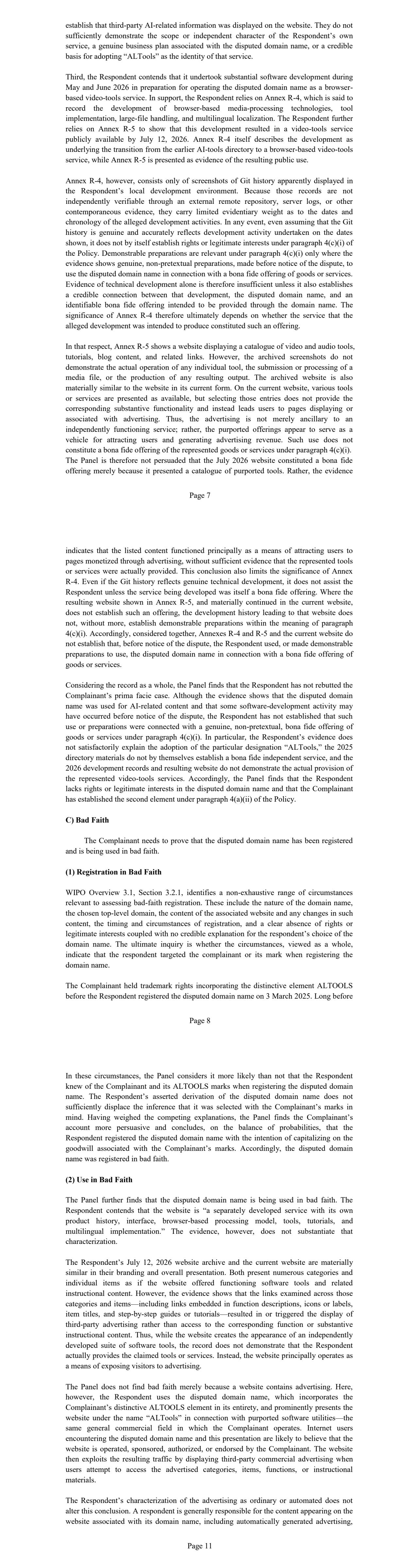
The first archived page displaying the project name was hardly impressive. It displayed “Alternative AI Tools,” but still contained the default WordPress welcome post. It was a beginning, not a mature business launched in an afternoon.
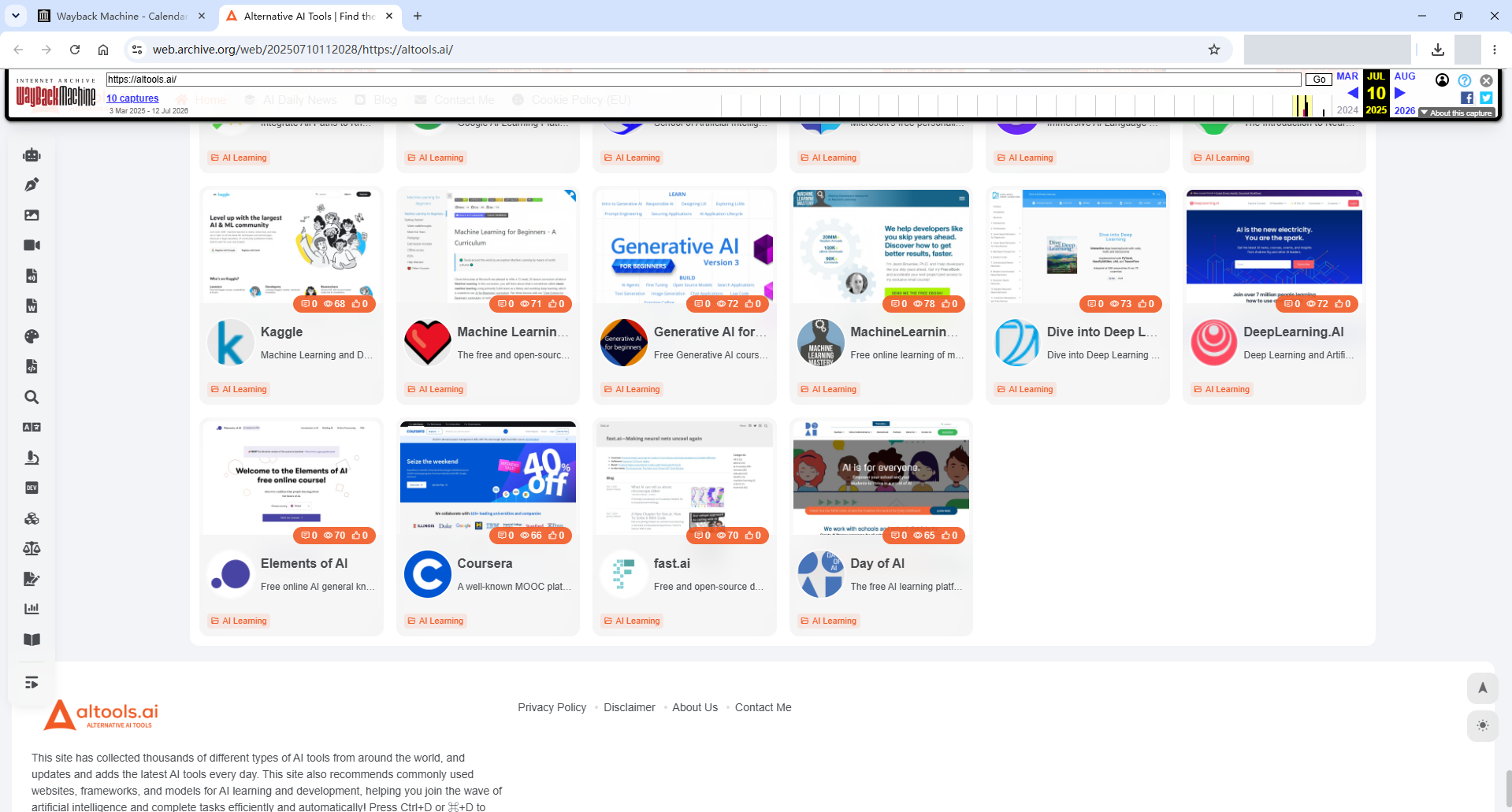
Over the following months, it grew into an AI-tools directory. Archived pages from July, August, and September show tool listings, AI-related posts, and a dedicated catalogue.
Then I had to answer the question that comes after making something: did people need another version of it?
The market was crowded. There were many similar directories, search visibility and traffic growth were disappointing, and I struggled to find a clear advantage.
Making the website and finding a reason for people to use it were two different problems.
I had tried an idea and learned something from the results. Now I needed to decide where to go next.
The problem behind the pivot
Suppose you want to compress a video.
Before you can do that small job, an online service asks you to upload the whole file. You wait for the transfer. Then you wait for processing. Sometimes you wait in a queue.
With a large file, the waiting becomes a substantial part of the task. Some services ask for payment. And if the video contains private footage or client material, you have another decision to make: whether to hand it to a third-party server.
These were the problems I kept noticing.
Browser-based alternatives existed, but local processing did not always feel good either. I was dissatisfied with the large-file experience of tools built mainly around traditional FFmpeg/WASM workflows, where memory pressure and processing time could still become obstacles.
Meanwhile, browsers were becoming more capable. I began thinking about hardware acceleration, newer media APIs, and what could happen on the user’s own device.
Could more media work stay inside the browser, without sending the file to a remote processing server? Could better use of local capabilities make that workflow more practical?
That became the new direction.
It did not mean browser limitations had disappeared. Performance would still depend on the device, browser, codec, and file. Nor should my interest in technologies such as WebGPU be mistaken for evidence that ALTools had already implemented them.
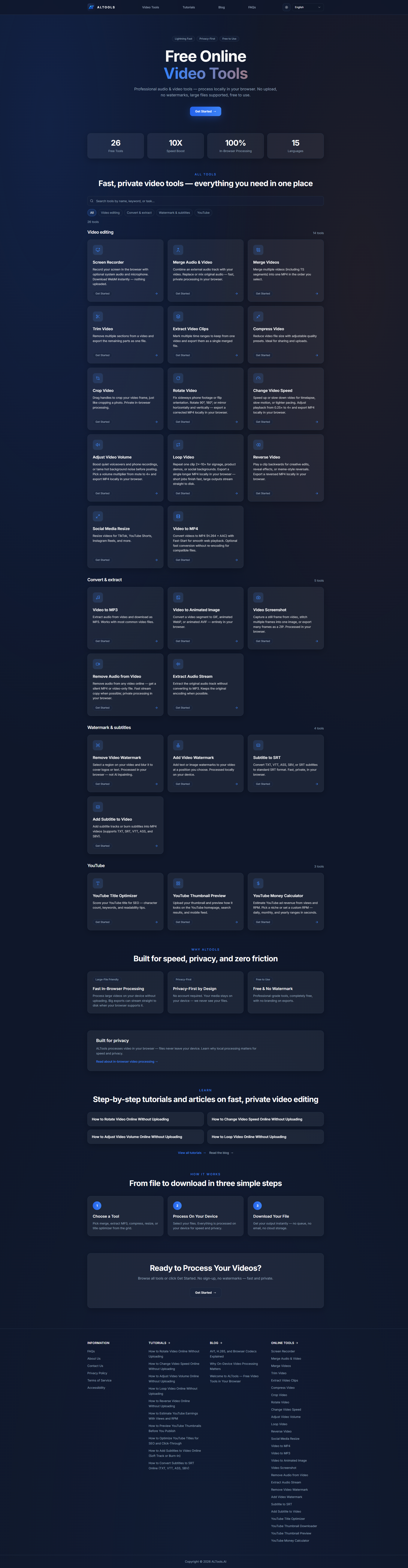
Development materials record work during May and June 2026. By July 12, a Wayback capture showed browser-based video tools, tutorials, blog articles, and multiple languages.
“Alternative AI Tools” no longer described the product well. The shorter ALTools name remained.
From my perspective, the sequence was straightforward: try a directory, observe weak results, and move toward a more concrete problem.
Then the work changed
Until the dispute, the questions were product questions. What should the site do? How could the workflow improve? Was this direction useful enough to pursue?
Then, in September 2026, I received a UDRP notice.
This was my first encounter with the Uniform Domain Name Dispute Resolution Policy. My first task was simply to establish whether the message was credible. Without reading and checking it carefully, I might have dismissed it as spam or a scam.
It was real.
ESTsoft, a Korean software company, was seeking transfer of altools.ai.
The complainant argued that the domain was confusingly similar to its trademarks, that I lacked rights or legitimate interests, and that I had registered and used it in bad faith.
My response disputed the latter two elements and denied that I had chosen the domain to target ESTsoft.
Suddenly, continuing to build the product was not the only task. I also had to explain why it existed.
I initially thought that a clear history would answer that question. The name had appeared at the beginning. The directory had operated for months. The video-tools transition preceded the dispute.
I thought the facts would speak for themselves.
When old pages became evidence
Before the dispute, an old screenshot was just an old screenshot.
Now it could answer questions I had never expected to defend: When did this name appear? What was the website doing then? Was the explanation offered today consistent with the project’s past?
I went back through registration records, Wayback captures, old pages, articles, and development history.
Materials originally saved as traces of the work became evidence about the work.
I submitted my response on September 15, before the stated deadline. Its annexes covered registration, the registration-day archives, the 2025 directory, development-history screenshots, and the July 2026 video-tools website.
The chronology was the heart of my argument. I said I had not known of or targeted the complainant when registering the domain, and that the later product reflected the evolution of my own project.
The continuous functionality recording and later Analytics screenshots discussed below were preserved after the decision. They were not part of that original response.
That distinction must remain clear: the panel could not have watched a recording that did not yet exist.
The decision
The decision was dated September 29, 2026. I received notification the next day.
The panel found for ESTsoft on all three UDRP elements and ordered transfer of altools.ai.
It found confusing similarity with earlier marks incorporating ALTOOLS, concluded that I had not established rights or legitimate interests through a genuine, bona fide offering, and inferred that I had known of and targeted the complainant’s marks when registering the domain.
Its reasoning considered the name, earlier trademark rights and reputation, the general technology field, later branding, advertising, and the website’s functionality.
The result was painful and deeply frustrating.
What troubled me most was the gap between the product history I had carefully assembled and the account of that product in the decision. A great deal of work had gone into explaining the sequence. The outcome left me feeling that important parts of it had not been fairly reflected.
The decision contains reasons. My disagreement concerns those reasons—not an unsupported claim about anyone’s motives.
Three issues remain central.
The tools that were supposed to be missing
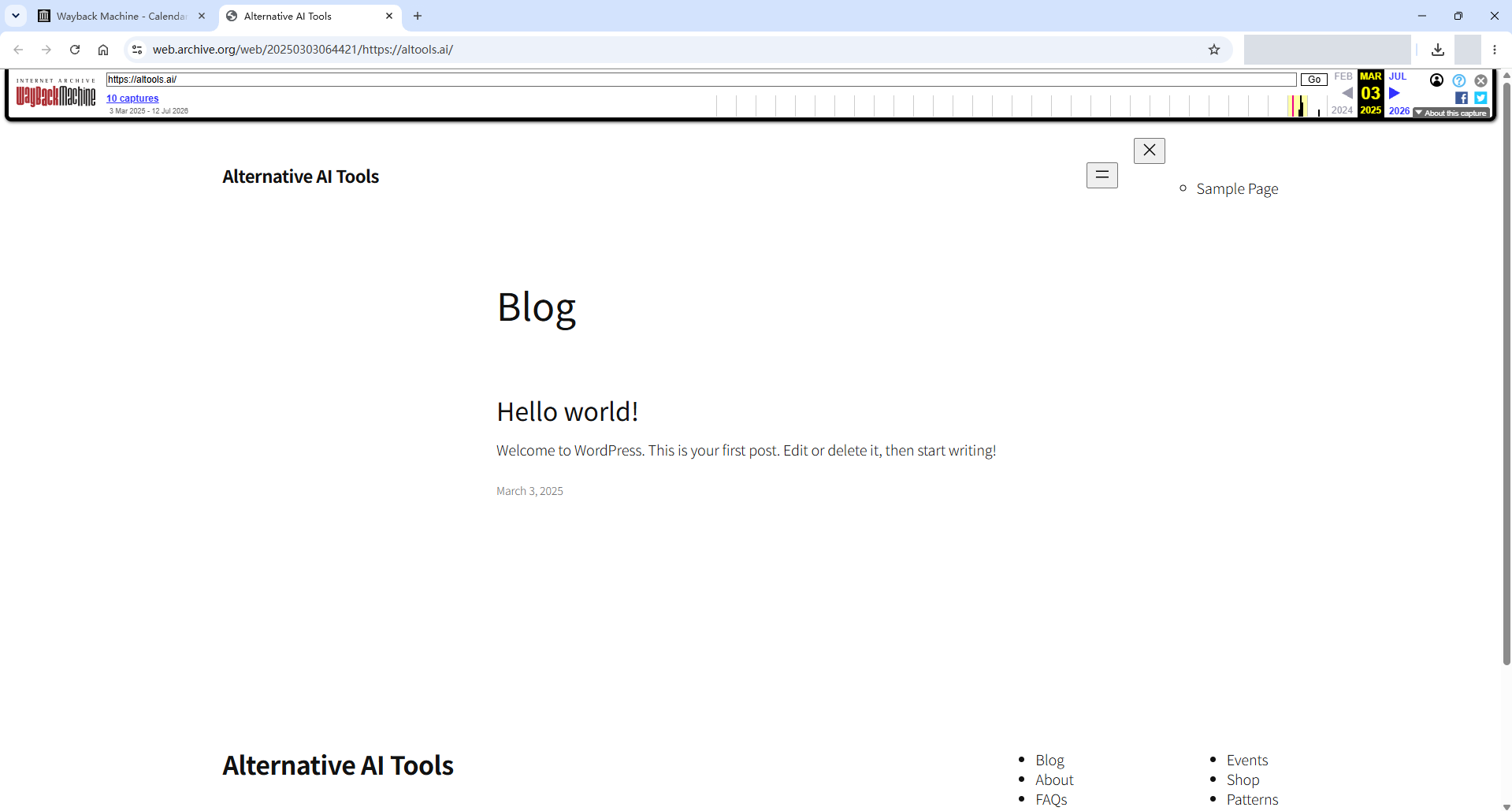
The panel described tool selections as failing to provide corresponding substantive functionality and leading instead to advertising. It characterized the website principally as a means of exposing visitors to advertisements.
This was not a side issue.
That factual premise helped support the rejection of a bona fide offering and legitimate interests. It reduced the significance of the development records and appeared again in the bad-faith-use analysis.
If the premise was wrong, its consequences extended beyond a single sentence.
On September 30, I made a continuous recording using ALTools’ own Screen Recorder. I did not change the tools or advertising functionality to produce it.
The session followed a sample video through conversion to MP4, compression, trimming, watermark addition and removal, video-stream extraction, audio-stream extraction, and merging audio with video.
The operations produced output files, which were opened during the session. I preserved the input, recording, outputs, and accompanying notes.
These were actual processing steps. The demonstration went beyond clicking through a catalogue of promised features.
It also included an advertising interruption. The website had ads, and I am not trying to rewrite that part of its history. An interruption could make a visit frustrating.
But an advertisement appearing and a tool performing real work can both be true.
In my view, the panel’s broad characterization of the product as lacking substantive functionality was factually wrong. Multiple tools performed actual work in the preserved tests.
The recording has limits: it was made after the decision, does not reproduce the panel’s browsing session, and cannot establish every tool’s condition at every earlier moment or across all devices.
Even with those limits, it records a functioning product immediately after the decision, without functionality being changed for the demonstration. That is a serious contradiction to the portrayal of a site principally substituting advertising for its represented services.
An unsuccessful attempt to reach a tool may establish an access problem. It does not, by itself, establish that the tool does not exist.
Because this premise mattered in more than one part of the reasoning, I believe it deserved much closer scrutiny.
Thirty-five minutes and forty-seven seconds
One record took me back to the first day.
The domain’s recorded creation time was 06:08:34 UTC on March 3, 2025. The Wayback capture displaying “Alternative AI Tools” was timestamped 06:44:21.
Thirty-five minutes and forty-seven seconds after registration, a third-party archive had already captured that name on the website.
It was not proof of everything. The page still contained default WordPress content. It did not establish a completed directory, and no screenshot can directly prove what was in my mind.
But it did establish that the phrase appeared long before the dispute or any need to prepare a defence.
The panel acknowledged that the archive had some probative value. It nevertheless found that the phrase did not adequately explain the particular domain name or establish an independently originated, bona fide project.
I understood ALTools, “Alternative AI Tools,” and the .ai ending as a suitable combination for the idea. The panel did not find that explanation credible enough.
I recognize the difference between verifying a page and verifying an intention. Still, I believe the timing deserved greater weight when assessing my account of the project’s origin.
A name appearing less than an hour after registration is not proof of intent. But it is very different from an explanation first appearing after a dispute begins.
The same history, read differently
The panel gave limited weight to the local Git screenshots because their dates were not independently verifiable through a remote repository or other external records.
It also found the directory and development materials insufficient to establish a bona fide offering. Later ALTools branding and a monetized technology website became relevant circumstances in its assessment of registration intent.
The third-party archives preserve distinct stages: the early name, the 2025 directory, and the July 2026 video-tools presentation. Local development materials sit between them.
These records do not prove every historical function worked. They do show more than a website suddenly assembled after receiving a complaint.
To me, the changes fit the experience of trying to find a useful product. The directory struggled. I changed direction. The longer name stopped fitting, and the shorter name remained.
The panel expressly said later conduct did not retroactively create bad-faith registration. It nevertheless used that conduct to evaluate my explanation of the original choice.
I believe the documented experimentation provides a more persuasive account than the inference that I began by targeting ESTsoft.
A working product does not automatically settle a trademark dispute. Its existence and history should still be assessed accurately before conclusions are drawn about its purpose.
A remedy on paper, a decision in real life
After receiving the decision, I asked ADNDRC whether the seven-day correction procedure could address what I believed was an objectively incorrect factual finding.
The reply said it was limited to clerical or similar minor errors, not factual challenges or new evidence. It identified court proceedings under UDRP paragraph 4(k) as the route for independent resolution.
That route existed. Court proceedings are distinct from an internal UDRP appeal. ICANN’s UDRP policy.
Then came the practical questions: legal fees, cross-border procedures, time, uncertainty, and the attention the product still needed.
A legal remedy can exist on paper and still be economically unrealistic for a small operator.
I am not presenting a verified litigation budget or predicting a court’s decision. I am describing the choice I faced.
The process had already been exhausting. Pursuing the dispute further would require resources that could otherwise go into operating and developing the product.
Choosing not to litigate did not mean agreeing with the decision.
I still believe it did not fairly reflect the documentary record. But I chose to put my limited resources into keeping the product alive.
What I hope another founder learns earlier
If another founder reads this before buying a domain, or before a dispute begins, there are things I hope they learn sooner than I did.
A domain purchased through a legitimate registrar or marketplace can still face a claim. An expensive domain is not legally untouchable merely because you paid for it. Price cannot replace an assessment of naming, trademark, and dispute risk.
And do not wait for a complaint before trying to reconstruct the product’s history.
Keep dated pages, published articles, early archives, development milestones, product versions, and appropriately scoped Analytics records. Record why the name was chosen and why the product changed.
Those records serve different purposes. Traffic does not prove successful processing. A homepage does not prove every function works. Local development dates may need external corroboration. Later demonstrations must be distinguished from earlier product states.
Evidence preservation does not guarantee an outcome. It gives the history a better chance of being examined.
I also learned not to assume that facts obvious to the person building a product will be equally obvious to the person assessing a dispute.
A process can reach a formal conclusion and leave serious questions about its factual foundation. Further legal options may exist, but their economic cost is part of the reality founders have to understand.
These lessons came with a cost. I would rather someone else consider them before facing the same choices.
A new name, and room to move forward
ALTools is now EZOnline.
The new domain, ezonline.tools, is live. Old ALTools links currently redirect to their corresponding new locations. Familiar tools remain available, and development continues.
Before changing the old website, I preserved its pages and the materials needed to explain this history.
Completing the migration brought relief. After a process that had consumed so much attention, the product had a new home and a way forward.
Keeping the record without living inside the dispute
I am not asking readers to accept my conclusion simply because this is my account. Selected, redacted records can help them independently assess whether the decision in KR-2600307 was fair and factually supported.
The complete original archive will not be published directly. It contains private correspondence, personal information, and internal records unnecessary for public understanding.
Journalists, researchers, established bloggers, and media organizations can contact EZOnline through its official contact channel. Depending on the request and privacy considerations, I may provide additional original material for fact-checking.
I also invited ESTsoft to provide a statement, clarification, or factual correction. Any response used should be presented accurately and in context.
I still disagree with the result. I will not pretend this experience never happened, and I will preserve the records needed to discuss it honestly.
But I do not want the product’s future to revolve around this dispute.
I chose not to turn these questions into years of litigation.
I chose to keep building.
That is why ALTools is now EZOnline.
The product’s story continues.
Supporting Record
KR-2600307 — altools.ai
The panel ordered transfer of altools.ai. This does not assert that the registrar has completed the transfer.
- ICANN UDRP policy
- Registration-day Wayback record — Figure 3
- AI directory archive — Figure 1
- Selected Decision passages
- Full functionality demonstration — Video 1
Short chronology
- 2025-03-03 — Domain record creation at 06:08:34 UTC.
- 2025-03-03 — First preserved project-name capture at 06:44:21 UTC, 35 minutes and 47 seconds later. Earlier captures show installation stages.
- 2025-07–09 — AI directory archives; not proof of uninterrupted daily operation.
- 2026-05–06 — Local Git/development history; the panel gave limited weight because dates were not independently verifiable.
- 2026-07-12 — Browser media tools archive; a page alone does not prove processing.
- 2026-09-02 — Complaint formally filed according to the Decision; distinct from the August 26 signature date.
- 2026-09-15 — Response submitted.
- 2026-09-29 — Decision dated; transfer ordered.
- 2026-09-30 — Notification, correction-scope inquiry and reply, and post-decision functionality recording. The panel had not seen it before deciding.
- 2026-10-02 — Pre-migration homepage preserved with advertisements blocked.
Official fact-checking contact
The complete original archive is not available for public download because it contains personal information, private correspondence, and internal records. Journalists, researchers, established bloggers, and media organizations may contact EZOnline through its official contact channel. Depending on the specific fact-checking request and privacy considerations, additional original material may be provided. This does not guarantee access to the entire archive. Unrelated third-party privacy will be protected.
Big Buck Bunny — © 2008 Blender Foundation / bigbuckbunny.org, CC BY 3.0.